It is common at first
Up to two-thirds of people have temporary, mild to moderate sensitivity early on. With trays or strips it usually appears within 2 or 3 days and resolves by the fourth day after treatment ends, according to the ADA.
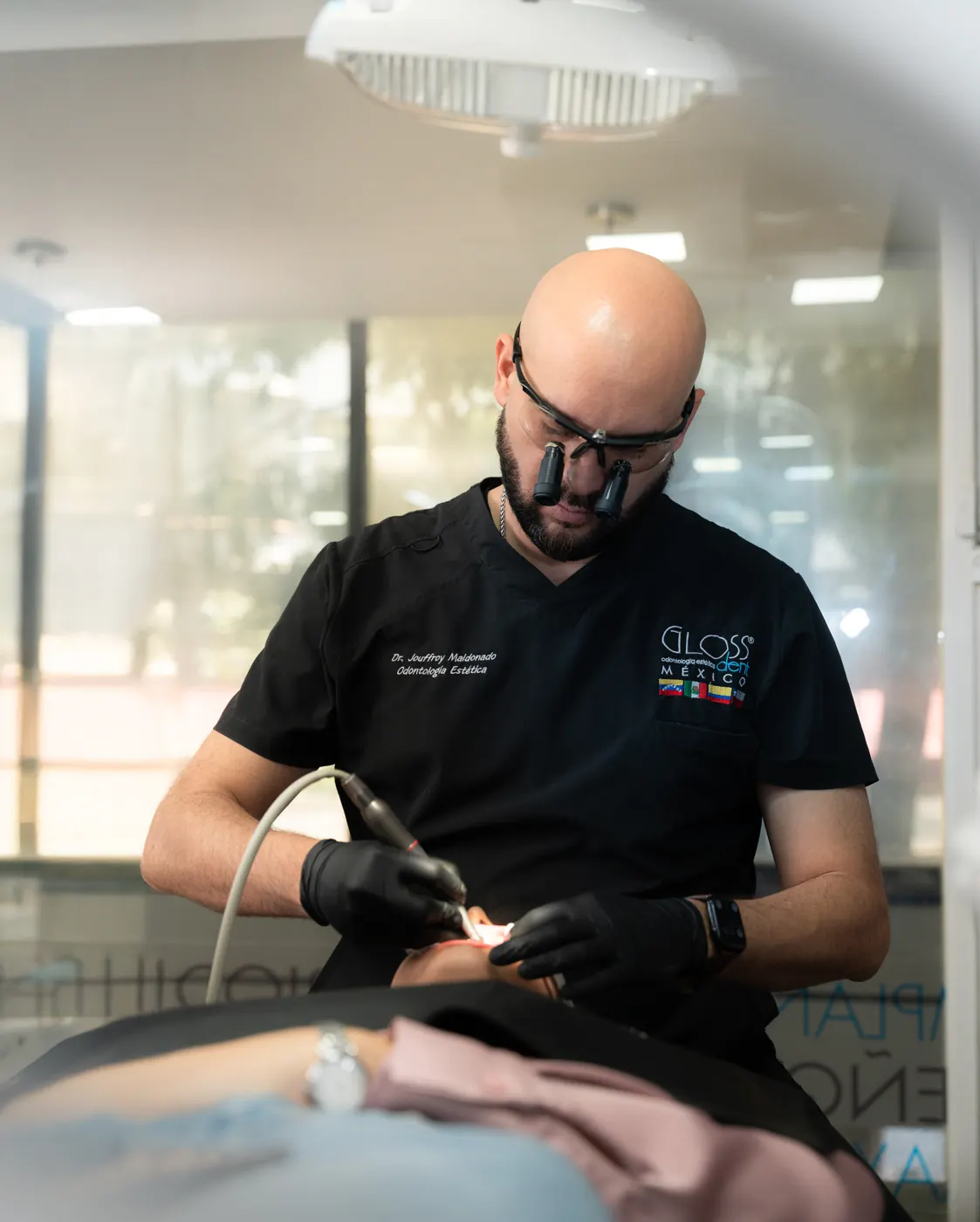
Gloss Dent Polanco
What whitening is, in the office or at home, who it suits and who it does not, sensitivity and concentrations, visits, aftercare and how long it lasts in studies. Clinic in Polanco.

What it is
Whitening lightens the natural color of the tooth with a hydrogen peroxide or carbamide peroxide gel, which breaks stains into smaller pieces. It only works on natural teeth: crowns, veneers, composite and implants do not change color.
Not every stain comes off with whitening, and it is not always the first step. At our Polanco clinic we check for cavities, gum health and your bite before any cosmetic treatment, and you receive a written plan with the alternatives.
Options
The two options supervised by a dentist are in-office whitening and at-home whitening with custom-made trays. Over-the-counter products use lower concentrations than a dentist's.
| In the office | At home with trays | |
|---|---|---|
| How it is done | The gums are protected with a shield or a gel, and a high-concentration gel is applied to the teeth. | You wear trays made to fit your teeth at home, with the gel and for the time your dentist indicates. |
| How long | Usually 1 appointment of 1 to 2 hours, according to the NHS. | 2 to 6 weeks, according to the NHS. In studies, 2 to 10 hours a day for 6 to 28 days. |
| Concentration | A high-concentration hydrogen peroxide gel. | According to the ADA, 10% to 38% carbamide peroxide; wearing time depends on the concentration. |
| Sensitivity | Similar risk to at-home whitening; in studies it was more intense. | Similar risk to in-office whitening; in studies it was milder. |
| Color change | No difference with shade guides; slightly less when measured with an instrument. | No difference with shade guides; slightly more when measured with an instrument. |
These are averages from studies (sources below), not a promise for your case. The evidence comparing at-home and in-office whitening is of low quality.
Is it right for me?
Sensitivity
Up to two-thirds of people have temporary, mild to moderate sensitivity early on. With trays or strips it usually appears within 2 or 3 days and resolves by the fourth day after treatment ends, according to the ADA.
At home, 20-22% carbamide peroxide gel carried 1.67 times the risk of sensitivity of 10% gel, with similar lightening (13 trials, most at high risk of bias). For in-office whitening, the ADA cites a review with less sensitivity when lower concentrations of hydrogen peroxide were used.
Gum irritation is the other common effect. With at-home products, sensitivity and irritation were more common at higher concentrations, and mild and temporary (Cochrane, with low to very low certainty evidence).
Potassium nitrate slightly reduced how intense it felt; painkillers and anti-inflammatories taken beforehand showed no useful preventive effect. If it appears, you can pause and resume; tell your dentist.
The process
Medical history and a check of cavities, gums and restorations, with X-rays if needed, to find out where the stain comes from. You are asked about past sensitivity and allergies. At Gloss Dent the first consultation takes about 90 minutes.
A professional cleaning reduces many surface stains; it can be done before whitening.
Which option, which concentration and for how long, which restorations will not change color and what to do if sensitivity appears. Mexico's NOM-013 standard requires consent to explain the alternatives in plain language.
The gums are protected with a shield or a gel, the whitening gel is applied and removed at the end.
Impressions of your teeth are taken to make the trays. When they are delivered, the fit is checked and you are shown how long to wear them and how to protect your gums.
Color and sensitivity are checked. If composite or veneers come next, their shade is chosen to match the new color, after some time has passed: whitening reduces immediate bonding to enamel.
How long it lasts
It is not permanent. According to the NHS, the effect may last around 3 years if you follow your dentist's advice; coffee, tea, red wine and tobacco stain the teeth again. There is no solid figure for how long it lasts: the figure at about 10 years comes from 30 people and from what they perceived.
| Study | What it found |
|---|---|
| NHS (2025) | The effect may last around 3 years if you follow the instructions. It is not permanent. |
| About 10 years later (Ritter 2002, 30 people) | After whitening at home with 10% carbamide peroxide, 43% perceived their color as stable 9 to 12 years later. In those examined, no resorption was found, and gums and tooth vitality were within normal expectations. |
| At home versus in the office (de Geus 2025, 32 studies) | The same risk of sensitivity, and milder at home. Color change measured with an instrument was slightly greater at home; with shade guides there was no difference. Low quality evidence. |
| At-home products versus placebo (Cochrane 2018, 71 trials) | They lightened teeth over short periods, from 2 weeks to 6 months, with low to very low certainty. The most common effects were sensitivity and irritation, more frequent at higher concentrations, mild and temporary. |
| Concentration at home (Cordeiro 2025, 13 trials) | 20-22% carbamide peroxide carried 1.67 times the risk of sensitivity of 10%, with similar lightening. Most trials were at high risk of bias. |
| With or without light (Maran 2018, 21 trials) | Light did not improve color change or affect sensitivity, with high or low concentrations of hydrogen peroxide. |
| Light and laser (Allende 2026, 10 systematic reviews) | Light or laser did not improve the final result or reduce sensitivity. With high-energy protocols, heat inside the tooth is a concern. |
These are averages for groups of patients, almost always over short periods. The NHS describes laser whitening as faster and more effective than gel alone, but systematic reviews did not find that advantage.
Aftercare
Use the gel for the time and as often as you are told. Overuse can damage enamel or gums.
Coffee, tea, red wine and tobacco stain the teeth again.
You can pause and resume later. Tell your dentist if it bothers you.
It is best to wait before bonding them: whitening reduces immediate bonding to enamel. How long to wait is decided for your case; no clinical review sets the number of days.
Where we are
Whitening assessments are by appointment. You can book online, call or message us on WhatsApp. If you are travelling from another city, confirm the number of visits before booking your trip.
Monday to Friday, 9:00 to 19:00, and Saturday, 9:00 to 14:00. Visits by appointment.
Common questions
It depends on the option (in the office or at home) and on whether cavities or gums need treatment first, or composite or crowns that show when you smile need replacing afterward. That is why at Gloss Dent the price is given after the assessment, with a written plan.
At first, for many people, yes: the ADA reports temporary sensitivity in up to two-thirds of users. The risk is similar at home and in the office, and at home it tends to be milder. Lower concentrations were associated with less sensitivity.
According to the NHS, around 3 years if you follow the instructions. It is not permanent: coffee, tea, wine and tobacco stain the teeth again.
Systematic reviews did not find that light or lasers improve the result or change sensitivity. The NHS describes them as faster and more effective, but studies did not confirm it.
No. Only natural teeth get lighter. If you have restorations that show when you smile, it helps to know beforehand that they may end up darker than your teeth and sometimes need replacing afterward.
Used as directed, a small group examined about 10 years later showed no damage to the gums, tooth vitality or enamel. The ADA notes that it can change enamel roughness and reduce the bonding of composite and ceramics, and overuse can damage enamel or gums.
The NHS does not recommend it. It is a precautionary recommendation, not the result of a study that measured the risk. It is not done for people under 18 either.
They have lower concentrations than a dentist's. The ADA suggests talking to your dentist first and looking for its Seal of Acceptance. According to the NHS, kits bought from a pharmacy or online and whitening at beauty salons do not work as well and may harm teeth and gums.
The criteria and figures on this page come from these sources. They are averages from studies, not a promise for any individual case.
We review your dental health, what you want to change and the options for your case, and you receive a written plan.